How the revenue question every hotelier asks led me to build a system focused on growth and ROI.
You’re looking for the answer to “How can we grow our revenue?”
That’s a big question.
Maybe you’re thinking about a new platform.
Maybe you think a bigger budget would solve it.
Or maybe you’re considering hiring an agency, or a better one.
The campaigns are going out. The tools are in place.
And when leadership asks what it's all producing, the connection from activity to results isn’t there.
Countless hoteliers ask, “How can we grow our revenue?” and that’s why I built the Marketing Co-Pilot, my 6-month program where I help marketing teams pr
If you recognize this question, this article is for you.
Let's get into it.
In this article, I'm sharing:
Why Hotel Marketing Teams Can Get Stuck, No Matter How Hard They Work
Every hotel I've worked with has a busy marketing team.
Worth asking: what are they busy with?
Here's what I kept seeing over 16 years of working as a fractional CMO for independent hotels.
Reason #1: The whack-a-mole priorities problem.
Every department has a deadline, and every deadline is urgent.
The restaurant wants a promotional flyer.
The commercial team needs an email campaign.
The spa is asking for a sales flatsheet.
Ownership wants to understand the shoulder-season plan.
The operations “go-to” pattern: if a task can't be easily defined and requires even a hint of creativity, it ends up on the marketing team's project board. Every department figures that out eventually.
And underneath it all: website optimization, the guest journey, the booking flow that leaks direct reservations every day. All of that work waits.
It waits because it isn't attached to anyone's immediate deadline. It isn't the loudest voice in the room.
When everything is urgent, the work that actually drives revenue gets buried.
Reason #2: The Reporting Gap.
Leadership wants to know if marketing is working. But the data they're looking at doesn't answer that question.
Social media reports impressions and reach. The CRM reports open rates and click-throughs. The OTA dashboard shows booking volume.
Each platform tells its own story, in its own format, in its own language. None of them connect to the commercial goals the hotel is actually trying to hit.
Sidenote: I wrote more about what that reporting structure should actually look like and how to build it here: 3 Tips to Prove Revenue Growth with Confidence.
The result: marketing presents activity, leadership sees numbers, and nobody in the room can draw a clear line from "we ran this campaign" to "here's what it did to our ADR and direct bookings." Marketing ends up justifying its existence in every pace meeting review instead of building on its wins.
A hotel can have a very active marketing team and still have no idea if any of it is producing revenue.
Reason #3: Marketing is often misunderstood, and the team can lack direction.
Many DOSMs (Directors of Sales & Marketing) came up through sales. They're strong at building a pipeline, managing outreach, and closing. Those skills are genuinely valuable.
But the digital landscape has shifted what marketing now needs to do.
Guests are being influenced and making discovery decisions long before they ever pick up the phone or open a booking engine.
AI search, content strategy, SEO, and brand positioning: this is where awareness and bookings now begin. Those capabilities don't automatically come with a sales background.
Without that expertise, and without a senior marketing voice to fill the gap, the team executes without a strategic filter.
Work gets done, but nobody is connecting what's happening to what the hotel is actually trying to achieve.
That’s the role I fill with the Marketing Co-Pilot.
I work alongside your team as the strategic lead. We define the priorities based on the biggest opportunities, month after month.
The three reasons teams get stuck show up first as reporting and priority problems.
These are real problems that the Co-Pilot is built to solve.
I’ve also seen what happens when they go unsolved for too long.
They shape how the people doing the work feel about their jobs, and over time, that shapes the team itself.
This leads to another problem, an even bigger one, as you’ll see in the next section.
The One Problem Few Hotels Factor In
All three of the problems above run deeper than results.
They affect the people doing the work.
Marketing already carries one of the highest turnover rates of any job function.
According to research from The Trust Agency and the Center for American Progress, a vacant marketing role takes an average of 54 days to fill, and replacing a specialist costs between 10% and 30% of their annual salary.
That's before you account for what leaves with them.
Research consistently points to the same root cause behind marketing turnover: overwork.
Research calls it “overwork,” but I think that’s what we call it when we don’t have focus, when everything is a priority, 1-2 people take on everything, and we’re not clear what we’re working for.
The activity stack grows, but more campaigns and more platforms don't compound into more bookings. What produces results is focused, strategic work on the right activities.
Hotels and hospitality have some of the hardest-working people on the planet. But those people need focus, a clear purpose, and to be shown how their work impacts the business.
When a hotel loses a marketing team member, it loses the history: the campaign context, the vendor relationships, the understanding of what worked last shoulder season and why. The new hire starts the learning curve from zero.
At the time of writing this article, there were an estimated 5,000 to 7,000 open hotel marketing roles across Canada and the United States. (source: LinkedIn and Indeed)
Those hotel properties aren't just short-staffed.
They're losing momentum on the strategic work that compounds over time, while the operational requests keep arriving at the same pace.
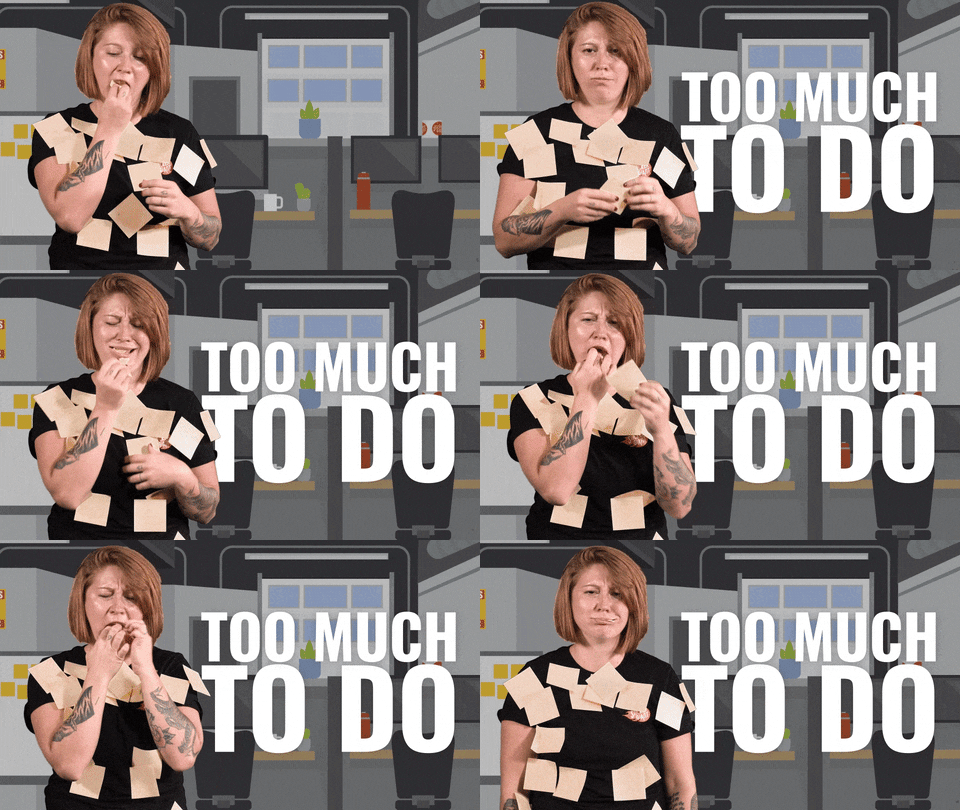
The conditions that lead to turnover are consistent: no strategic direction, so nothing ever feels focused. No support structure, so every decision gets made in isolation. No opportunity for real collaboration, so someone who wants to build something with a team ends up working alone.
That combination creates friction, creates frustration, and eventually leads good people out the door. The infrastructure to make the role sustainable wasn't there.
Those conditions aren't permanent. With a plan, reactive requests don't derail the week. When marketing connects visibly to commercial results, the person doing it wants to stay.
When someone is in the team's corner to think through ideas and build alongside, the work starts to feel like it matters.
The hotels that keep their marketing people are the ones where the work feels focused, supported, and connected to something real.
That pattern: the reactive cycle, the invisible reporting, the team without direction, and the talent drain that follows.
Before I get into the details of the Marketing Co-Pilot that I built to address these challenges, let’s take a moment to look at why the options most independent hotels reach for don't actually solve the problem.
Why the Usual Options Don't Close the Gap
When independent hotels recognize one or all of these problems, they typically look at one of three options.
Option 1: Hire a Director of Marketing.
A dedicated Director of Marketing sounds like the right move for most independent properties. Here's what that decision typically looks like in practice.
What most independent properties actually need is someone who can step back from the task list, see how all the marketing activity connects at the strategic level, and prioritize what needs to happen next. According to research from The Trust Agency, it also takes an average of 54 days to fill a senior marketing role. A Director of Marketing brings significant salary and overhead at $90,000 to $131,000 (source: salary.com), plus payroll and equipment costs.
When that person leaves, their understanding of the property, the context, and the institutional knowledge goes with them.
Option 2: Bring in a Marketing Agency.
Most marketing agencies feature a list of services in the same way you would order from a restaurant menu.
Do you want chicken, steak, fish, or pasta?
It’s why Hotels often have agency and vendor relationships based on the marketing channel.
Social media goes to one agency.
Google Ads goes to another marketing agency.
SEO with another agency.
A fourth manages the website.
Email marketing runs through a platform with its own support team.
Each partner may be doing competent work within their lane. Each provides reports on their “channel,” but someone still needs to ask the bigger questions.
How does all of this work together?
How are all of the channels driving more bookings?
Which of these activities is supporting the hotel's current rate targets? Where are the gaps, missed opportunities, and what should stop or keep doing?
Without someone with that full-picture view, a hotel can end up with four or five active vendor relationships and no coherent strategy connecting them.
There's a real example of this later in this article: a property running Google Ads on autopilot for months, campaigns never evaluated against commercial results. That's an active vendor relationship without a strategic filter.
Option 3: Stay in reactive mode and hope the team figures it out.
This is the default for most independent hotels, and most of the time it happens by circumstance.
Hiring a Director of Marketing takes months.
Finding the right agency mix takes time. While those decisions are being weighed, requests keep coming, ad deadlines keep appearing on the calendar, and the team keeps absorbing whatever lands on the project board.
The longer it runs, the harder it gets to step back. The team adapts to the pace. Leadership adapts to imperfect reporting. The question of whether marketing is actually driving revenue gets moved to the back of the agenda, where it waits for a better moment that never quite arrives.
The path of least resistance becomes the path, until the pattern is so embedded that changing it feels like its own project nobody has time for.
The Marketing Co-Pilot I built steps in the gap between those three options.
Most independent hotels have agencies, tools, and teams doing the work. The gap is structural: nobody holds the full commercial picture, keeps the knowledge intact, or filters out what doesn't deserve the budget or attention.
The Marketing Co-Pilot way of working with hotels is built to fill that gap.
What makes it different comes down to three things.
{1} Everything connects to your revenue goals.
Co-Pilot starts with what you're actually trying to achieve: better ADR, higher occupancy, more direct bookings. Every marketing activity ties back to one of those targets.
{2} The knowledge builds and stays.
Property knowledge, ownership dynamics, what worked last shoulder season and why: it all accumulates in the relationship and compounds over time.
When agencies rotate account managers or a Director of Marketing moves on, that context walks out the door. With the Marketing Co-Pilot, all of the knowledge and reporting stays with you.
{3} A filter on your budget and attention.
Every independent hotel gets pitched constantly: new platforms, advertising packages, partnerships, sponsored placements.
Co-Pilot vets every opportunity against your priorities before committing your time or money.
Often the right call is "not now" rather than a flat no. Staying focused on what's already working produces better results than chasing what looks good in any given pitch.
Understanding where that approach comes from matters.
Here's the experience behind it.
How My Experience as a GM Led Me to Build Marketing
I came into hotel marketing from the inside.
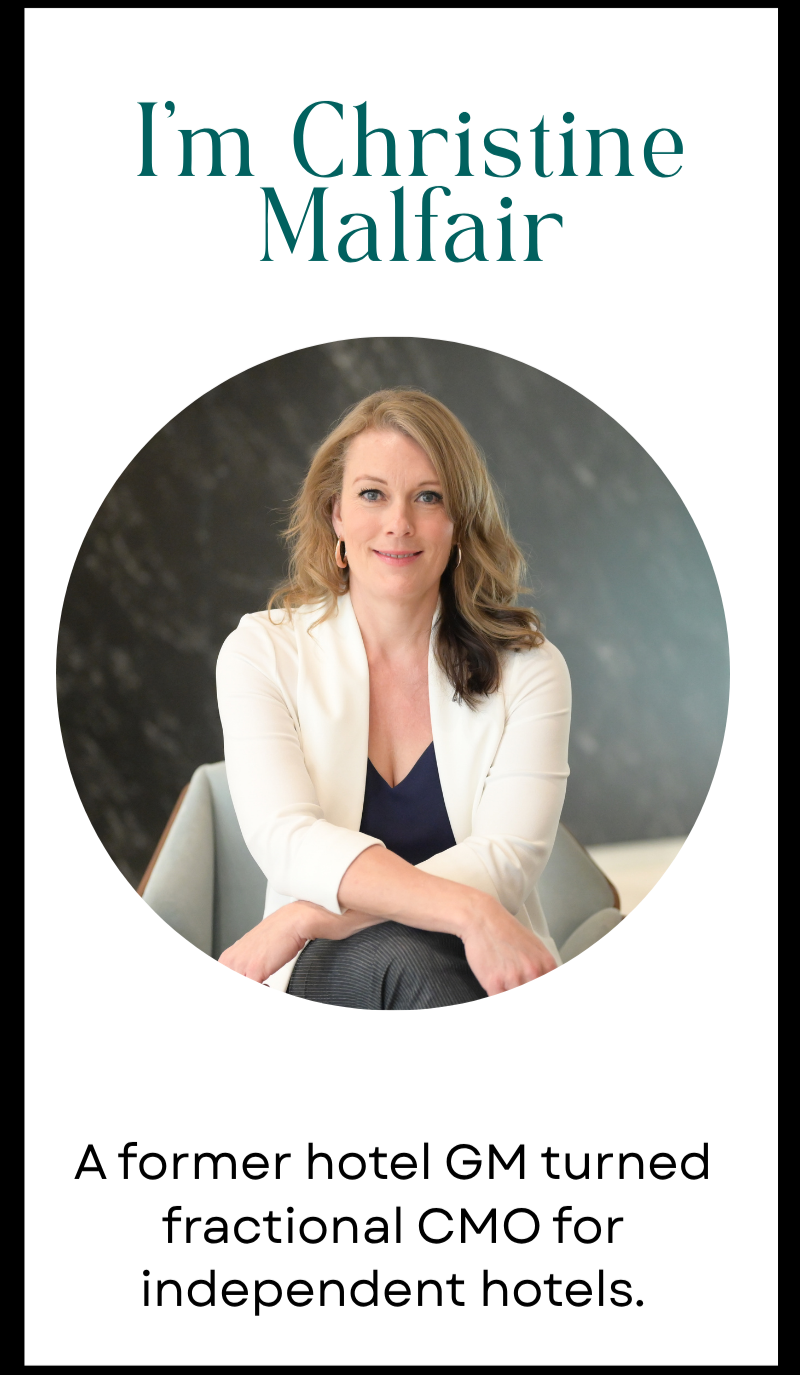
Before founding Malfair Marketing, I spent nearly a decade in hotel operations as a GM. During that time, I was also the one figuring out the marketing, on my own, with a limited budget, looking for information anywhere I could find it.
I was trying to be a good steward of the hotel's money and spend it in places that would actually yield results.
When you’re an independent hotel with a limited budget, you get scrappy and figure things out. You make the call with the information you have.
What I didn't have was someone to think through ideas with. Someone to talk through an idea with, push back on an opportunity that looked good but didn't fit where we were headed, or help me connect what we were spending to what we were actually trying to achieve.
That absence is part of why I built the Marketing Co-Pilot. I knew exactly what was missing, because I'd felt it myself.
When I moved into marketing strategy and started working with independent hotels, I brought that operator lens with me. I've managed P&Ls with ownership watching closely. I've read the monthly pace report and had to explain the gap.
I've watched a comp set make a rate move and decided in the moment how to respond.
The questions I ask when I look at a hotel's marketing are operator questions.
Where are we losing guests who should be finding us?
What's the gap between discovery and conversion?
What does ownership need to see to understand how marketing is doing its job?
My hotel-ops commercial foundation is what makes the Co-Pilot partnership different.
I understand what the numbers mean and what's at stake when they move.
What Changes When Your Hotel Marketing Team Has a Co-Pilot
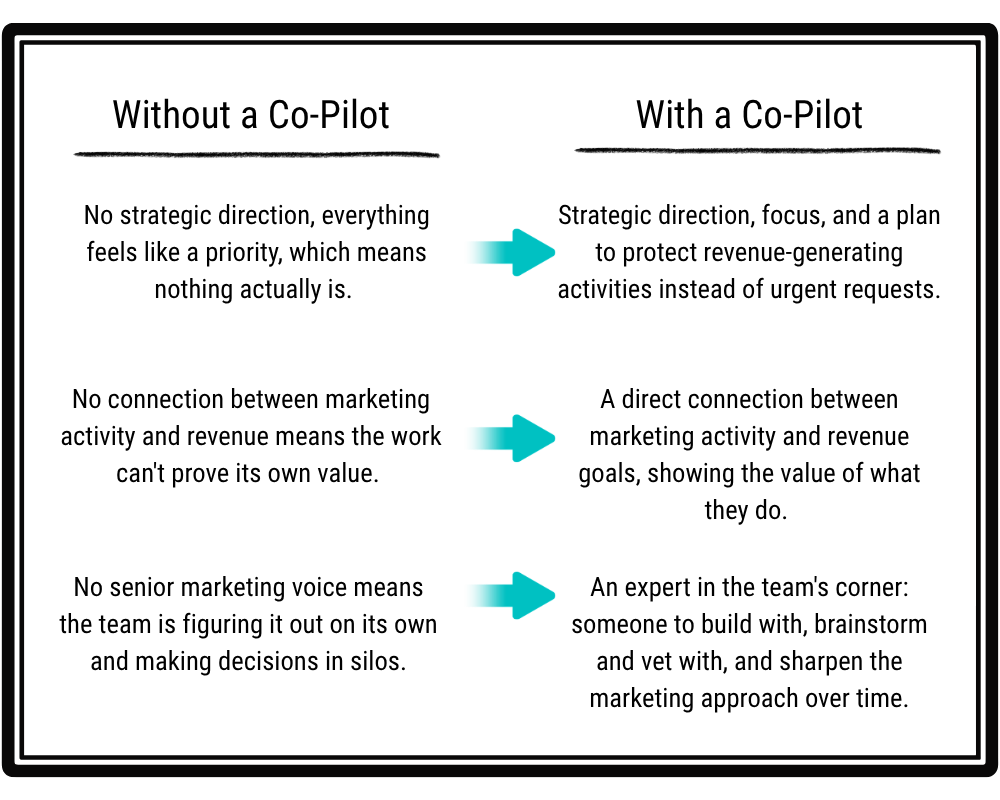
The problems I talked about earlier
- the whack-a-mole priorities
- the reporting gap
- and leadership uncertainty all point to the same gap.
The Marketing Co-Pilot resolves those issues so your marketing person stops thinking the grass is greener somewhere else.
They get the work done in an organized, methodical way that helps them be more successful.
Here’s an illustration for easy comparison.
Now, as for the name - Marketing Co-Pilot.
If you've spent any time with my work, you know I reach for car metaphors.
I almost called this way of working with hotels “Riding Shotgun”.
As in the term people use for the front passenger seat of a vehicle next to the driver.
I liked the reference, but thought I should leave the term “gun” out of any of my work.
I don’t think Google would have liked that. Agree?
So Marketing Co-Pilot it is.
Envision this. I'm in the passenger seat with the map, telling you when to turn left, when to turn right, how far the next off-ramp is, and making sure we don't blow past the exit every time a shiny new marketing opportunity appears.
Co-Pilot is more professional than the feet-up-on-the-dash style I just described, but the dynamic is exactly the same.
Here's exactly how it works.
Every Co-Pilot engagement I do with hotels follows a framework I call the Hotel Revenue Engine. It runs on six gears, each one purposefully driving a different part of your hotel's commercial performance. The gears are designed to work together: when one turns more efficiently, it creates momentum across the others.
{1} We start with a diagnostic.
First, we assess what's going on: what's working, what isn't, and where to focus first. I lens every piece of digital marketing activity through the Hotel Revenue Engine, review performance across each lever, and identify gaps.
The goal is to move from reactive to focused as fast as possible, with a clear picture of what the marketing needs to accomplish and in what order.
⭐Within the first month, you have a prioritized focus through a custom-built 90-day plan. You can share the plan with your team and present to ownership with confidence.
{2} We work the plan together.
Co-Pilot runs on 90-day planning cycles. We meet bi-weekly to review the implementation plan and progress, and adjust based on shifts in your demand patterns or competitive set.
At the strategic level, I take ownership of the direction: what we're focused on, what we're moving away from, and why. The hotel team handles task execution. You always have full visibility into what's being worked on, what's coming next, and where things stand.
⭐ You always know the status of the plan. Nothing is happening in the background that you can't see.
{3} We build the reporting and KPI dashboard.
Co-Pilot builds the reporting structure that connects your marketing activity to ADR, occupancy, and RevPAR. You get a dashboard you can open at any point to see how things are tracking, ready to bring into any ownership conversation or strategic review.
⭐Every leadership review becomes a results conversation. You walk in with a dashboard that shows exactly what the marketing is producing and where the growth is coming from.
{4} You have a senior marketing voice available when a question comes up.
Between our scheduled calls, I'm an email away.
When a question surfaces, a problem needs a quick read, a strategic decision needs a second opinion, or a marketing opportunity lands in your inbox, you get a direct answer, fast.
⭐Opportunity vetting is one of the most frequent ways Co-Pilot protects the budget.
Independent properties get pitched constantly: partnerships with publications, advertising packages, sponsored placements, platform deals.
Often the right call is "not now" rather than a flat no. We're three weeks into a focused 90-day plan, and pulling attention toward something new costs more than the opportunity is worth. We review every pitch against your strategy, your priorities, and where the property is in its current cycle.
⭐High-stakes marketing decisions don't have to be made alone.
You have a direct line to a senior marketing perspective before you commit, and someone to help you stay the course when a compelling opportunity arrives at exactly the wrong moment.
A Case Study and What Clients Say About Working Together
Some hotel marketing looks active on every platform and still drains the budget without producing results. The right strategy does two things: it identifies where to grow and where to stop.
At a mid-sized independent hotel I worked with, we focused on a repeat guest strategy and better-connected reporting. The work paid off, contributing $133,000 in year-over-year direct channel revenue growth, a 3.3% increase driven by shifting attention to the activities that were actually producing bookings.
In another, a review of a property's Google Ads account uncovered campaigns set up incorrectly and left running without oversight. An agency hired to manage Google Ads set them up, but the account was never adjusted or optimized.
I paused the campaigns and provided the agency with new campaign instructions. Performance improved over six months; the property saved $12,000 in ad spend that previously had been producing very little return. Shortly after my recommendation, the agency revoked my access and kicked me out of the account. I guess they didn’t like my recommendation, but the hotel sure did!
A senior marketing partner's most valuable contribution is knowing exactly what to stop and where to redirect focus instead.
Numbers tell part of the story. The other part is what Co-Pilot does for the people doing the work. Many hotel marketing professionals are carrying the full function alone, with no one inside the organization to think things through with.
One independent hotel client described it directly: "It's good to have a sounding board, someone I can talk to about ideas. I'm a marketing team of one, and there's just not a whole lot of people to talk to."
Having someone to think with changes how decisions get made, and how the person making them feels about the work.
The relationship I value most is the long one. Continuity lets strategy compound. What we build this year becomes the foundation for next year. A revolving door of marketing hires can't replicate that, and most agency relationships aren't built for it either.
“Growth, prosperity, and knowledge over 10 years largely due to Malfair Marketing. Continuity and stability that is difficult to replicate with an internal position.”
What owners and DOSMs value most, across 16 years of this work, is someone who understands the full picture: the commercial reality, the operational constraints, the ownership dynamics. Marketing decisions made in isolation from those things don't hold up.
“Christine possesses a deep understanding of our business dynamics and operations. She excels in strategic thinking, enabling us to view our challenges and opportunities from a big picture perspective. I’ve enjoyed working with her and would highly recommend her services.”
The thread across every long-term engagement: when hotels have strategic marketing direction, the work gets better, the team gets more stable, and the numbers prove themself.
The hotels that are investing in this kind of working relationship today are building something that compounds. And the landscape they're building it in is shifting in ways that raise the stakes for getting this right.
Where Independent Hotel Marketing Is Heading
Independent hotels are one of the most compelling products in travel.
They stand out on their own, with no flag or franchise name.
They aren’t cookie-cutter cut-outs from another hotel across the country.
They have a distinct character and a guest experience that a branded property genuinely cannot replicate.
The landscape for Independent Hotels is also shifting in ways that raise the stakes for getting the marketing right.
AI is already reshaping how travelers search, compare, and make decisions. Answers are drawn from across the internet and presented directly to guests before they ever visit a hotel's website. That creates both a challenge and an opportunity for independent properties.
The challenge: independent hotels cannot afford to let OTAs, platforms, or intermediaries define who they are and who their ideal guests should be. Every booking that flows through a third party is margin given away and a direct guest relationship handed off.
The opportunity: hotels that build a clear, well-documented brand presence are positioned to take back that margin and that relationship. Guests and AI tools alike can find, understand, and trust them before a competitor appears on the screen.
This is margin defense and a chance to play offense at the same time.
That foundation is what makes an independent hotel genuinely hard to displace. A strategic direction, a clear brand story, a plan ownership can see and trust, and a marketing team supported enough to stay and build. Those things don't replicate overnight.
That's what I'm building toward with every Co-Pilot engagement.
If you're ready to stop leaving margin and brand control on the table and start operating from a plan that connects to your revenue goals, the next step is a conversation.
Is a Call with Christine the Right Next Step for Your Hotel?
Getting on a call with Christine makes the best sense if any of these describe where your property is right now.
Your marketing team is in reactive mode, and ownership keeps asking why all that activity isn't translating to more direct bookings or better ADR.
You've hired and fired more than one marketer in the past few years. The role never quite worked. The structure around those people wasn't there to support them.
You have an agency managing campaigns. But nobody connects that spend to your commercial goals, and you're not sure what you're actually getting for the money.
You're the DOSM carrying strategy, execution, and ownership reporting at once, with no senior marketing voice to think things through with.
You're about to make a significant marketing investment: a new platform, a campaign, a partnership. You want someone to pressure-test it against your strategy before you commit.
If one or more of those fits, we'll have a 30-minute conversation about your specific situation: where you are, what you're working toward, and whether Co-Pilot is the right structure to get you there.
The Marketing Co-Pilot is an application-based engagement. I work with a small number of properties at a time, and I'm selective about fit on both sides.
Frequently Asked Questions About the Marketing Co-Pilot
-
Both, depending on what your property needs. Co-Pilot is a working partnership. We build the strategy together on regular calls; I direct the focus and priorities, and the hotel team handles execution. You always know what's being worked on and what's coming next.
-
An agency typically manages a specific channel or campaign type. Co-Pilot is property-level marketing strategy. I'm looking at your full commercial picture: visibility, conversion, team direction, and what ownership needs to see, and building the plan that connects all of it. That's a fundamentally different role.
-
Most properties see meaningful shifts in the first 90 days: a focused marketing direction, a cleaner reporting picture, and at least one quick win on direct bookings or traffic. The longer-term outcomes build from there: ADR improvement, stronger direct booking performance, and a more stable marketing team.
-
Yes. Co-Pilot is designed to work alongside an existing team. Your coordinator gets strategic direction instead of just a task list, which is one of the most effective things you can do for both their output and their retention.
Enjoyed this Article?
Sign up for the Bookings Boost - a quick read newsletter with revenue growth tips and strategies for how independent hotels actually operate.