Get more direct bookings from the website traffic you already have.
"You can't take clicks to the bank."
Back when I was a hotel general manager, running marketing alongside everything else a GM handles in a day, a mentor said to me, “You can’t take clicks to the bank.” I nodded along, because it sounds obvious. It kept working on me, though. The more I turned it over, the more I realized he had handed me 90% of the job in seven words.
In hotel marketing, you need two things to happen, arguably three things:
You need more lookers, which means more reach.
You need more of those lookers to act, which means more bookings.
And you need them to come back, which means more rebookings.
Now look at where your attention goes.
Reach, getting more people to your website, gets the budget, the agency conversation, and the first slide of the marketing report.
Rebooking, getting more repeat guests, gets mentioned in the marketing plan.
What happens between reach and rebooking is what I want to talk about today.
It’s the one hotels spend less time on.
Here is how it showed up in my work with hotels. I looked at a year of booking path data for a property I work with, and the first thing I found was good news.
More guests landed in the booking engine than the year before. Up 5.6% was great, especially in a year when traffic was down.
It means each of those people chose the property, opened the calendar, and started looking at dates and rates. They were shopping, not just browsing. More of them did it than the year before, on less traffic.
That 5.6% improvement meant the homepage, the room pages, the photos, the reviews, and every call to action on the site were doing their job. It is a real win, and it is the kind of win most marketing reports never surface, because nobody is looking at that number.
But then I looked at what happened to those guests once they were inside the booking engine.
The share of them who finished had dropped by 16%.
More people are arriving ready to book, but fewer are completing a reservation.
The flow was happening, but something was getting in the way.
If your traffic looks healthy and your bookings have gone flat, this one is for you.
In this article, I will show you how to find your own conversion number, the four places on the booking path where guests decide, and what to look at in each one.
Reach and rebooking are their own conversations, and I will come back to both.
This is the same process I work through with hotels in Marketing Co-Pilot, my ongoing partnership where I sit beside your team as the strategic lead to prioritize activities and budget for higher ROI (return on investment) and more revenue.
I’ll share more about how that works at the end.
In this article, I'm sharing:
The Look-to-Book Calculator: What your website traffic could really be worth $$
FIVE factors that influence whether guests book or leave
What to do if you don’t control your hotel’s website
How I help hotels improve conversion inside the Revenue Roadmap and Marketing Co-Pilot
Why conversion is a hotel's biggest revenue opportunity.
Most of a hotel's marketing spend goes toward getting more people to the website.
Conversion works on the people who are already there.
They are already on your website, your social media page, or clicked on your Google Ad.
That demand is real, and you've already paid the cost to reach them.
In the Marketing Co-Pilot program, I apply the Hotel Revenue Engine. It’s my five-lever framework to power revenue growth for independent hotels, and conversion is gear #3.
It is where money tends to move fastest. It is also the most misunderstood number on the marketing report, and the decimal point is why.
Every other number a hotel runs on arrives at a scale people can feel.
ADR is a dollar figure. Occupancy is a percentage that swings in whole points. Website traffic is counted in thousands. Say any of those in a revenue meeting and the room knows straight away whether it is good news. Conversion arrives as 1.89. 2.0. or 2.5.
When you tell leadership that you want to take the website from 2.0 to 2.25, you will get a polite nod. Meanwhile, they’re thinking - Woop-de-doo! It sounds like a rounding error. It sounds like the kind of goal you set when you have run out of real ones.
A decimal point doesn’t seem like much, but the revenue gain it hides is huge.
Here is why that decimal point should get your attention.
Independent hotel websites typically convert somewhere between 0.5% and 3.0%. That is a six-fold spread across properties selling similar rooms, to similar guests, in similar markets.
The range reveals that conversion rates can be ignored or improved.
Look at what 0.25 of a point is actually worth! 👇
A property running 24,000 website sessions a month at a $650 average booking value.
Going from 2.0% to 2.25% is 60 more reservations a month.
60 reservations at $650 = $39,000.
Over a year: 720 reservations and roughly $468,000 in direct revenue.
This is why a conversion goal can be the single biggest revenue accomplishment in your year.
Most marketing plan items compete for the same budget, and you have to buy every win again the following quarter.
But a better conversion rate keeps paying off. Every month, more of the visitors you’ve already paid for turn into bookings.
Many hoteliers I talk to cannot tell me their website conversion rate.
It is not in the marketing report, so it doesn't show up.
If you know yours, even roughly, you are ahead of most.
If you don’t, I’m here to help and show the real revenue opportunity that comes from improving your conversion rate.
See what your website traffic could really be worth.
This is where it gets really exciting.
Let’s size up your hotel’s revenue growth opportunity based on your current traffic.
First, you’ll need your current conversion rate.
Take your # of bookings, divide by website sessions, then multiply by 100.
Type in your website sessions, choose the period (month, quarter, year)
Enter the current conversion rate, set a goal, and see what it is worth at your property
Conversion Calculator
See what your current traffic could really be booking
A small lift in your website conversion rate turns into real reservations and revenue on the traffic you already have. Put in your numbers and see the gain.
Your numbers
Example values, edit themThe opportunity
Added reservations
per quarter
Added revenue
$520,000 a year
Bookings on the same traffic
This is an exciting opportunity that I would love to help you accomplish. Let's get 30 minutes on the calendar to talk about what this would mean for your property.
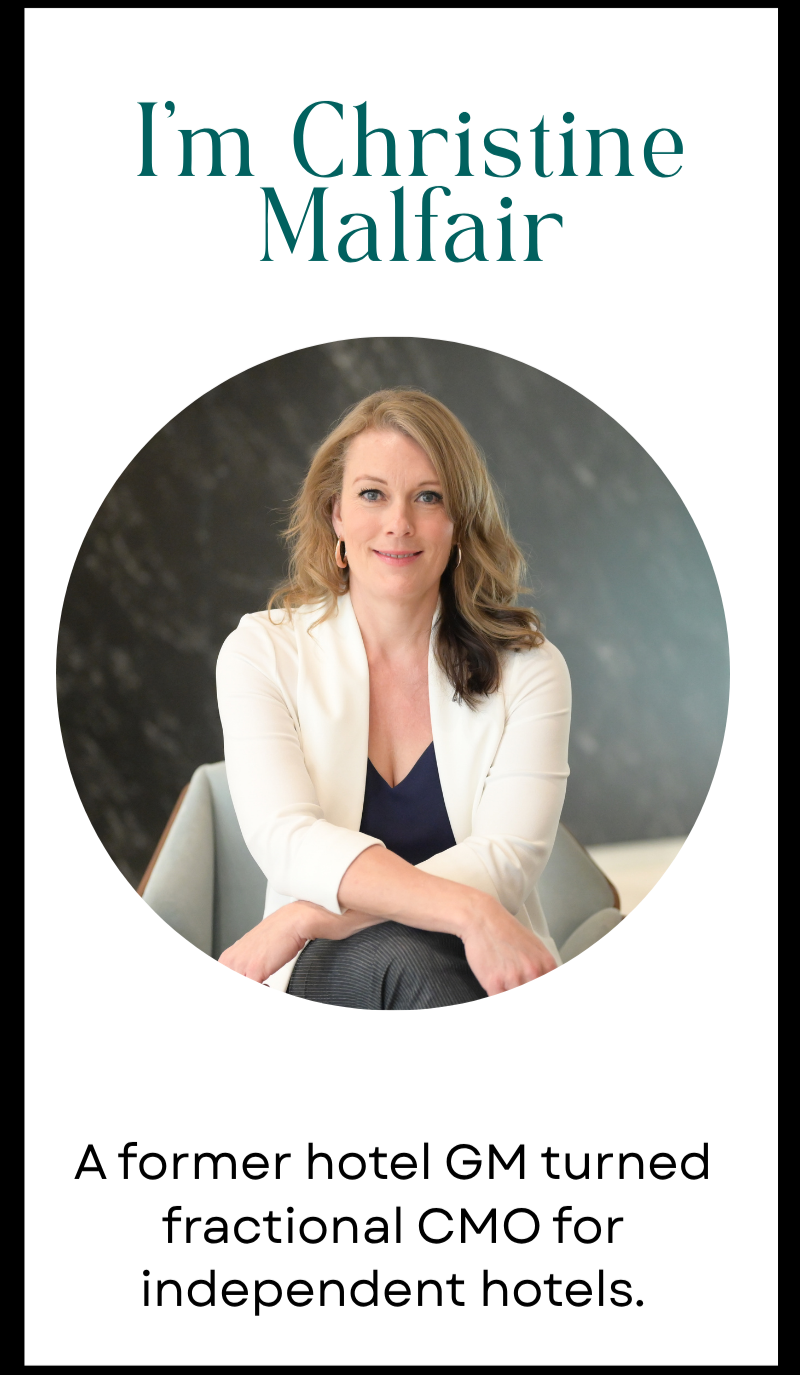
Book a Hotel Growth CallMalfair MarketingI spent 10 years running independent hotels before I started helping them get more revenue from their marketing. I help hotels find what's working, what's not, and what to do next.
That’s pretty mind-blowing, isn’t it?
Now let's look at some of the top factors that can boost your conversion rate.
5 Factors that Improve Your Hotel Website’s Conversion Rate
Plenty of factors decide whether a visitor looks and books or leaves. These are the five I look at first when I start working with a hotel in the Revenue Roadmap or Marketing Co-Pilot.
Small changes in each one add up to more bookings from the traffic you already have.
This is the work worth doing.
1. A Homepage with clear messaging that tells and sells
A guest arrives at your homepage already expecting something.
They’ve come from your Google Business Profile, an OTA listing, an ad, or ChatGPT told them about you before they clicked. When the homepage continues that message, the guest feels they’ve landed in the right place and keeps going.
If the pre-website message and what they see on your website don’t align, they get confused; friction and trust erosion set in. They likely will leave, and that’s a missed opportunity.
The first few seconds matter most.
Nielsen Norman Group, the user experience research firm, found that visitors spend about 57% of their page-viewing time above the fold, and 74% in the first two screenfuls.
In addition to the right message, you need a great image or short video that tells and sells.
It tells the story of who your hotel is for (ie., families, couples, weddings) and what the main experience is.
People scroll, but not far.
That’s why I like to run a hotel homepage through Donald Miller’s 8-second caveman test from his StoryBrand framework.
In eight seconds, a guest should know what you offer, who it’s for, and how to book.
In the Marketing Co-Pilot, the strategic advisory work I do with hotel clients, it’s one of the first things we fix.
Now that they like what they see, you need to reduce the risk a guest feels before booking. That’s where #2 comes in.
2. Show Proof through Guest Testimonials
Many say that testimonials increase trust.
I think their power is reducing risk.
A guest is about to spend several hundred dollars on a stay they can’t see first.
Reviews and testimonials lower that risk, and they work best when they sit next to a decision point, like a button or link on room pages and in the booking path.
Another effective option is to add a trust row to your website.
A trust row shows your rating across third-party platforms like Google and TripAdvisor, so guests can quickly get an overview and feel good about choosing you.
3. Well-Worded and Strategically Placed Calls to Action (CTA)
I’ve worked with over 25 hoteliers, and many have told me, “There’s a Book Now button in the top menu; we don’t need another one on the page.”
The trouble is that many guests scroll before they’re ready to book.
The ‘Book Now’ button in the top menu scrolls away with everything else. Some guests will scroll back up to find it, and some won’t.
That’s why I always recommend placing a call-to-action (CTA) button or link right where a guest is likely to be ready to act.
The wording matters too.
When working with hotel clients, we determine what the best wording is for the Call to Action (CTA) to invite them to take the next step.
In parts of your website, I find that “Check Rates for Your Dates” is a softer invitation than “Book Now,” so more guests click it.
When they do, what comes next needs to do another important job - make the booking.
4. A Friction-Free Booking Engine Experience
The booking engine is where your highest-intent guests make their final decision.
They’re used to checking out on Amazon in two steps, and your booking engine gets measured against that whether you like it or not.
The biggest drop-offs happen when guests have to click through extra screens to see a price, or when resort fees, parking, and taxes only show up on the last page.
A client once told me their $25 resort fee could sit at the end of check-out because, by then, the guest had put in too much effort to leave. That may have held up a decade ago, but today, guests have too many options, and it’s enough to turn them away.
Most booking engines also offer more changeable settings than hoteliers expect.
One property I work with in Marketing Co-Pilot added a small graphic inside the booking engine telling guests a welcome extra is on its way once they book. It costs very little and shows up at the exact moment a guest decides whether to finish.
But sadly, most hoteliers leave the booking engine alone because they assume nothing can be changed. You are spending real money to get guests this far. Advocate for the booking and ask your provider what is configurable, specifically steps, required fields, and what can be displayed inside the flow. I ask these questions on behalf of my clients.
One more factor I haven't mentioned, and it might be the biggest.
5. How fast your website loads and responds
Google has used speed as a ranking factor since 2010.
As of May 2026, only about 49% of mobile pages pass Google’s Core Web Vitals tests for speed and stability.
In my experience, hotel sites often fall short for structural reasons.
High-resolution galleries, videos, drone footage, and virtual room tours.
Third-party booking engines and availability-calendar scripts.
Pop-ups, cookie banners, and dynamic pricing elements that shift the layout as they load.
You can check yours for free with Google PageSpeed Insights.
What If You Don't Control the Website?
Not having access to the website is a real constraint for hoteliers. Many lack a backend website login, development resources, and the authority to approve website spend.
Every change goes through a queue, a vendor, or an owner.
That constraint limits what you can execute. But it does not limit what you can lead.
You can identify where conversion is being lost, quantify its value, estimate the cost to fix it, and present a business case to the people who decide.
These 3 lines are usually enough to get a decision-maker’s attention.
Here is what it costs to improve. (Hint: it’s less than you think)
Here is the revenue that is available if we do (reference the look-to-book calculator above).
Here is what we are choosing if we leave it. Show the downside.
That reframes the ask entirely.
The ask goes from “really, another website change?” to “wow, that’s quite an ROI opportunity!”
Even if you don’t control the website, you have more influence than you think.
When you can show where guests drop off and what it’s worth to fix, you give decision-makers a reason to say yes. That’s leadership, and owners notice it.
Picture walking into your next PACE meeting and saying, “We’re getting more bookings from the same traffic.” That’s a revenue-generating hero moment. 🦸♀️
Most of these fixes don’t require a website redesign.
Start small with the one costing you the most bookings.
Here’s how to find it.
How Do I Find Out Where My Website is Losing Bookings?
Here’s what you know from reading this blog post:
How to calculate your conversion rate
The $$ dollar value opportunity based on the look-to-book calculator
The 5 places guests decide, and what to look at in each one.
👉 The hardest question is which area costs you the most, and where to start.
That is the work I do inside Marketing Co-Pilot, my ongoing partnership with independent hotels.
As a senior marketing director, I put myself in your corner without adding a full-time salary to the payroll. You keep your team and your budget, and I provide strategic direction to ensure every dollar and activity is accountable to your hotel’s goals.
Every Co-Pilot engagement starts the same way, with a Revenue Roadmap. It is a diagnostic of your property's whole digital presence, every channel and every place a guest can find you, and it answers four things:
Where revenue is being lost
What is working
What is not
What to do next
Conversion is a large part of that, and it is usually where the Roadmap finds the fastest money. From there, you get a phased action plan, sequenced so a busy marketing team can actually work through it without stopping everything else.
Going back to the property at the beginning of this article.
🎯If its booking engine had maintained the close rate it had the year before, that property would have taken 449 more reservations, worth roughly $346,000 at its average booking value.
Those were guests who had already chosen the hotel, already picked their dates, and were already filling in the form.
That is the lowest-hanging revenue for your property.
Revenue opportunities are ready and waiting.
If you know you could be getting more from your marketing,
click here to book a free 30-minute Hotel Growth Call
We’ll roll up our sleeves and look at your numbers together.
In 30 minutes, we’ll:
Look at your traffic, bookings, and conversion rate
Find where guests are dropping off on your booking path
Talk about which fix would bring in the most bookings first
You’ll leave knowing your first move and whether the Marketing Co-Pilot looks like a good fit for your hotel.
Frequently Asked Questions About Hotel Website Conversion
-
Independent hotel websites typically convert between 0.5% and 3.0%, with unimproved properties at 0.5% to 1.5% and strong performers at 3.0% to 5.0% or higher. Compare yourself to your own trend line first. A move from 2.0% to 2.72% represents a 36% improvement and shows up in revenue immediately.
-
Purchases divided by total website sessions. Your booking engine reporting shows completed bookings, and Google Analytics shows sessions. Pull both for the same date range.
-
Conversion, in most cases. When your site converts well, every additional visitor is worth more. When it does not, a traffic push results in more people leaving. Improving conversion also costs less than buying more traffic. As a group sales expert, my friend Cory says, “Fix the holes in your boat before inviting more passengers aboard.”
-
Your booking engine. Try to make a booking on your own phone, start to finish. If it takes more than two minutes, you have room to work with. Then go through every form field and ask whether you truly need it to take a reservation. Finally, call your vendor and ask what you can improve in your setup. They want you to be happy with the system and to renew your contract, so they are usually motivated to help, and most booking engines offer more configuration options than the default setup suggests.
-
Usually not. Most of what I have described here is copy, placement, proof, and form fields. A redesign is a much larger project, and it does not automatically fix any of those things.
Enjoyed this Article?
Sign up for the Bookings Boost - a quick read newsletter with revenue growth tips and strategies for how independent hotels actually operate.