How to Get More Bookings Without Spending to Get More Traffic
"You can't take clicks to the bank."
Back when I was a hotel general manager, running marketing alongside everything else a GM handles in a day, a mentor said to me, “You can’t take clicks to the bank.” I nodded along, because it sounds obvious. It kept working on me, though. The more I turned it over, the more I realized he had handed me 90% of the job in seven words.
In hotel marketing, you need two things to happen, arguably three things:
You need more lookers, which means more reach.
You need more of those lookers to act, which means more bookings.
And you need them to come back, which means more rebookings.
Now look at where your attention goes. Reach gets the budget, the agency conversation, and the first slide of the marketing report. Rebooking (repeat guests) is discussed as a goal in the marketing plan. The one in the middle, the moment a looker becomes a booker, is the one most hotels don’t spend as much time on.
That middle number, lookers to bookers, is the one I want to talk about. Why? Because it is often ignored and where I have seen revenue show up fastest.
Here is how it showed up in my work with hotels. I looked at a year of booking path data for a property I work with, and the first thing I found was good news.
More guests landed in the booking engine than the year before. Up 5.6% was great, especially in a year when traffic was down.
It means that every one of those people had chosen the property, opened the calendar, and started looking at dates and rates. They were shopping, not just browsing. And more of them were doing it than the year before, on less traffic.
That 5.6% improvement meant that the homepage, the room pages, the photos, the reviews, and every call to action on the site was doing the job. It is a real win, and it is the kind of win most marketing reports never surface, because nobody is looking at that number.
But then I looked at what happened to those guests once they were inside the booking engine. The share of them who finished had dropped by 16%. Uh-oh.
More people arriving ready to book, but fewer of them actually completing a reservation.
The flow was happening, but something was getting in the way.
If your traffic looks healthy and your bookings have gone flat, this one is for you.In this article, I will show you how to find your own conversion number, the four places on the booking path where guests decide, and what to look at in each one. Reach and rebooking are their own conversations, and I will come back to both.
In this article, I'm sharing:
What Is a Good Conversion Rate for an Independent Hotel Website?
Most hoteliers I talk to cannot tell me their website conversion rate. It is not on the marketing report, so it does not come up. If you know yours, even an average, you’re ahead of most.
Here is the formula:
Purchases divided by total website sessions.
That is it. If 24,000 people visited your website last year and 480 of them completed a booking, your conversion rate is 2.0%.
For context, independent hotel website conversion typically ranges from 0.5% to 3.0%. Industry analysis published on Hospitality Net puts basic or unimproved independent properties at the low end, 0.5% to 1.5%, while high-performing boutique and luxury independents can reach 3.0% to 5.0%.
This range proves that conversion is a number you can influence.
In the Hotel Revenue Engine, my six-lever framework for independent hotel marketing, lever #3, conversion, is the lever where money tends to move fastest.
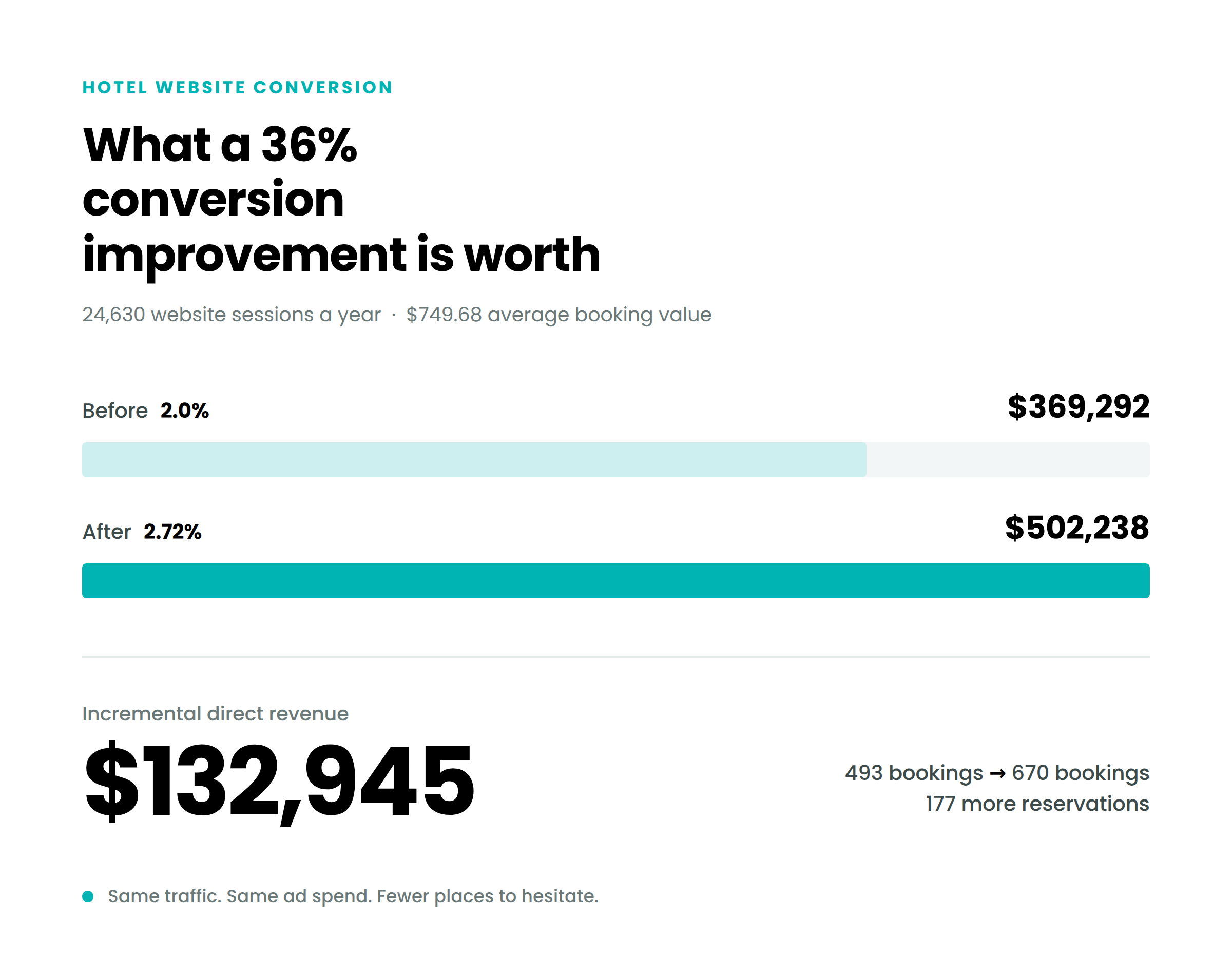
Here’s what this looks like in real revenue numbers.
Wouldn’t that be nice! No additional traffic, no additional ad spend, just more business from the traffic you’re already getting.
Conversion is a beautiful thing.
Now let's look at what impacts conversion, starting with what happens before the guest ever reaches your site.
How Do You Make a Hotel Homepage Convert?
Two things have to line up before a guest considers booking: the message that leads them to your homepage, and what the homepage does in the first few seconds.
Start with what I call "priming."
Your homepage does not operate on its own. Guests arrive from Google, your Google Business Profile, an OTA listing, social, email, and ChatGPT, and each of those told them something about you before they clicked.
Say your Google Business Profile reads "Waterfront resort in the Okanagan with spacious suites and lake access." Someone clicking through expects waterfront, Okanagan, suites, lake. If your homepage opens with Escape. Relax. Reconnect., they have to do mental work to confirm they landed in the right place.
Connect the promise made before the click to the message they see after the click.
This happens because websites get left in set-it-and-forget-it mode, which is good for crockpots and bad for marketing. Social media and email get monthly attention while the homepage looks the same as it did three years ago, even though it’s the place that every marketing activity points to.
So before you touch the homepage, audit what you are saying everywhere else: search snippets, your Google Business Profile description, OTA listing copy, social bios, ad copy, email links, directory profiles. Does the promise before the click match the message after it?
Then look at the first eight seconds
Nielsen Norman Group, the user experience research firm, found that visitors spend about 57% of their page-viewing time above the fold, with 74% in the first two screenfuls. People scroll, but not far.
I like to run a hotel homepage against what Donald Miller calls the 8-second caveman test in his StoryBrand framework. If a caveman landed on your homepage, could he tell three things in eight seconds?
What you do
Who it is for
How to get it
Most hotels handle the first one. The photography says hotel, and the logo says the name. Where they lose the guest is on "is this for me?"
That question is harder, because answering it means choosing. You have to decide which guests you serve, know what they care about and what they actually do while they are with you, and say it plainly at the top of the page.
A family of five needs to know the place exists for families. A couple wants to hear the spa is the main event. A corporate traveler is looking for something else entirely, and if you speak to all three at once, you speak to none of them.
Does your homepage pass the caveman test?
Now they know what you offer and that it fits. Next, they need enough confidence to pull out a credit card.
How Do You Reduce the Risk a Guest Feels Before Booking?
If you were thinking, you’ve got to show proof, you’re right.
Few things influence a booking decision as much as a strong testimonial from a past guest. Instead of putting them on a separate “review” page, add them as a trust-builder on contextual pages like rooms, dog-friendly, near rates, and in the booking path itself.
Then add a trust row: the small graphic that shows your review volume and rating across the platforms guests already check.
Trust rows and testimonials do two jobs at once.
Everyone talks about building trust. But reducing risk is what really gets people to buy.
The guest is about to spend several hundred dollars on something they cannot inspect first, on a trip that may have taken months to plan. The volume of reviews tells them other people took the same chance. A specific testimonial tells them what it was like and if it’s for them.
We’re 3 tips into this article, and now your website is doing a really good job of keeping guests engaged.
They know what you offer, that it fits, and that the risk has been reduced. Now it’s time to tell them what to do.
Where Should the Call to Action Go on a Hotel Web Page?
Your call to action (CTA) is the button that sends a guest into the booking engine, and it is one of the most common fixes that comes out of a Revenue Roadmap.
I have had hoteliers tell me, "There's a Book Now button in the top menu; we don't need one on the page."
For a “frequent-flyer guest” who has stayed with you before, reads the top of the page, and books immediately, that is true.
But many guests like to scroll a little. And if your top menu button scrolls away with everything else, the moment the guest is ready to act, there is nothing in front of them.
A well-placed, well-worded CTA (call to action) meets the guest at the moment they have what they need to act.
Three things to look at:
{1} Place the button where the guest is ready to use it.
That could be after the content that answers the guest's question. If a room page describes the suite, shows the view, and shows the proof, that is where the button belongs.
{2} The wording tells them what happens next.
"Book Now" is fine. What I have seen work better is something like "Check Rates for Your Dates," because it lowers the commitment level required to click. Avoid words that sound like work, like " learn " and "read "; they defeat the purpose of making it easy.
{3} Copy near the button or link does real work.
A short line near the call to action about what they get by booking direct gives guests a reason to use your path rather than go back to the tab where they found you. Think of this as the nudge.
OK, you’ve now got a great CTA, and they’ve clicked on it. Your booking is in the home stretch and now in your booking engine. This is the highest-value moment in the entire guest journey. What’s that booking experience like?
How Do You Improve Conversion in the Hotel Booking Engine?
The booking engine is the final stage of the booking path, where the highest-intent guests decide whether to complete the booking.
Amazon is the mega retail giant and for good reason. It’s easy, and checkout takes 2 steps.
That is the standard your guest is accustomed to, and your booking engine is being measured against, whether you like it or not.
Here is the objection I hear. "That works for Amazon. We are stuck with whatever our booking engine vendor gives us."
That is less true than most hoteliers think. There are a few things you can change.
Every step you remove between "I want to stay here" and "I have a confirmation number" is a chance to reduce drop-offs.
There are a number of things I recommend hoteliers do; here are three:
{1} Show prices up front, and show the right prices.
The initial search-to-room selection stage is where the biggest drop-offs occur.
Making a guest click through two screens to find out what a room costs adds a step and adds doubt. Then make sure the rate itself reflects the value you deliver and what is happening in your comp set, because your guest is shopping while they are sitting in your booking engine.
My observation has been that a guest will stay with you if the price is the same or even up to $4 higher. When it gets $5 or more, especially for multi-night stays, they go looking.
{2} Take the surprises out.
Resort fees, parking, cleaning charges, and taxes that show up on the final screen are one of the fastest ways to lose a guest who was ready to book.
A client once told me the resort fee could sit at the end, because by that point the guest had put in enough effort that they would not back out. That logic held up better a decade ago. Guests have more options now, and the technology is faster, so leaving costs them nothing. Put the full cost in front of them early. A guest who sees the real number and keeps going has already accepted it.
{3} Give them a reason to finish.
People love free stuff and bonuses. Any value add the guest genuinely wants, presented right there in the booking flow, helps tip a looker into a booker. One property I work with runs a small inline graphic in the booking engine letting guests know a welcome extra is on its way to their inbox once the booking is complete. It costs very little, and it arrives at the exact moment a guest is deciding whether to finish.
The 3 I just listed are my favorite booking engine tips, but here are a few more.
Cut your form fields to what a reservation actually requires, because nobody needs a licence plate number to take a booking.
Offer Apple Pay and Google Pay so guests do not have to get up to find their wallets.
Put a short testimonial or a photo in the flow so the rate isn't the only thing on the screen.
Write room descriptions that let a guest tell which room is the right fit, and while you are in there, count your room types. I have seen 80-room properties offering 14 of them, which is more choice than any guest needs and more than most can work through.
Each one takes out a second or a doubt.
Seconds and doubts are what a close rate is made of.
None of that list is a secret. You could find most of it in an afternoon. The hard part is knowing which one is costing your property the most right now, and in what order to go after them.
Most hoteliers leave the booking engine alone because they assume there is nothing to change. Ask your provider what is configurable, specifically steps, required fields, and what can display inside the flow. You are spending real money to get guests this far. Advocate for the booking.
There is one more factor I have not mentioned, and it might be the biggest one of all.
Does Website Speed Affect Hotel Bookings?
Google made site speed a ranking factor in 2010, so I keep expecting not to have to say this. Here I am saying it.
As of May 2026, about 49% of mobile web pages pass Google's Core Web Vitals, which are technical tests of load speed, responsiveness, and visual stability. In my experience, hotel sites tend to sit below that line for structural reasons.
High-resolution galleries, videos, drone footage, and virtual room tours.
Third-party booking engines and availability calendars loading scripts.
Pop-ups, cookie banners, and dynamic pricing elements that shift the layout as they load.
All of this slows your site down. Run your homepage and your top room page through Google PageSpeed Insights, which is free. Take the result to whoever manages your site and ask what the plan is.
What If You Don't Control the Website?
This section is for the reader who agrees with everything above and does not have the access or the budget to act on it.
It is a real constraint. Plenty of DOSMs have no CMS login, no development resources, and no authority to approve website spend. Every change goes through a queue, a vendor, or an owner.
That constraint limits what you can execute. But it does not limit what you can lead.
You can identify where conversion is being lost, quantify its value, estimate the cost to fix it, and put a business case in front of the people who do decide.
These 3 lines are usually enough to get a decision maker’s attention.
Here is what it costs to improve.
Here is the revenue that is available if we do.
Here is what we are choosing if we leave it.
That reframes the ask entirely. It stops being marketing about wanting another website change and becomes a revenue opportunity with an attached investment, which is a conversation ownership already knows how to have.
You may not control every lever that moves revenue. Knowing which ones matter, building the case, and influencing the decision constitute commercial leadership, and that is what typically gets noticed.
Putting It Together
Four places on the booking path where guests decide: your homepage, your proof, your calls to action, and your booking engine.
None of this requires a website redesign. It requires knowing which friction points are costing you the most, and fixing those first.
This work is methodical. It asks for surgeon-like attention to detail, and it will never be the exciting slide in the deck. It is also the work that changes what you bring to a pace meeting, because more bookings from traffic you are already paying for is a very good sentence to say out loud.
Ready to Find Out Where Your Booking Path Is Losing Guests?
You now know the formula for your conversion rate, the four places guests decide, and what to look at in each one.
The harder question is which one is costing you the most right now.
That is the work I do inside Marketing Co-Pilot, my ongoing partnership with independent hotels. It puts me, as a senior marketing director, in your corner without adding a full-time salary to the payroll. You keep your team and your budget, and I help with strategic direction to ensure every dollar and activity is accountable for achieving your hotel’s goals.
Every Co-Pilot engagement starts the same way, with a Revenue Roadmap. It is a diagnostic of your property's whole digital presence, every channel and every place a guest can find you, and it answers four things:
Where revenue is being lost
What is working
What is not
What to do next
Conversion is a large part of that, and it is usually where the Roadmap finds the fastest money. From there, you get a phased action plan, sequenced so a busy marketing team can actually work through it without stopping everything else.
Here is the kind of thing that surfaces. Going back to the property at the beginning of this article. If its booking engine had maintained the close rate it had the year before, that property would have taken 449 more reservations, worth roughly $346,000 at its average booking value. Those were guests who had already chosen the hotel, already picked their dates, and were already filling in the form.
That is the lowest-hanging revenue for your property, because you have already paid for every one of those guests to get there.
If your traffic is healthy and your bookings are flat, I would start with the booking path.
Book a discovery call at malfairmarketing.com and let's look at your numbers together.
Frequently Asked Questions About Hotel Website Conversion
-
Independent hotel websites typically convert between 0.5% and 3.0%, with unimproved properties at 0.5% to 1.5% and strong performers at 3.0% to 5.0% or higher. Compare yourself to your own trend line first. A move from 2.0% to 2.72% represents a 36% improvement and shows up in revenue immediately.
-
Purchases divided by total website sessions. Your booking engine reporting shows completed bookings, and Google Analytics shows sessions. Pull both for the same date range.
-
Conversion, in most cases. When your site converts well, every additional visitor is worth more. When it does not, a traffic push results in more people leaving. Improving conversion also costs less than buying more traffic. As a group sales expert, my friend Cory says, “Fix the holes in your boat before inviting more passengers aboard.”
-
Your booking engine. Try to make a booking on your own phone, start to finish. If it takes more than two minutes, you have room to work with. Then go through every form field and ask whether you truly need it to take a reservation. Finally, call your vendor and ask what you can improve in your setup. They want you to be happy with the system and to renew your contract, so they are usually motivated to help, and most booking engines offer more configuration options than the default setup suggests.
-
Usually not. Most of what I have described here is copy, placement, proof, and form fields. A redesign is a much larger project, and it does not automatically fix any of those things.
Enjoyed this Article?
Sign up for the Bookings Boost - a quick read newsletter with revenue growth tips and strategies for how independent hotels actually operate.